How to Organize Medications for an Elderly Parent
If you have ever stood in a kitchen at nine at night holding a pill bottle and trying to remember whether your mother already took it, you are not disorganized. You are doing a job that requires a system, using only your memory.
Most older adults take several prescriptions from more than one doctor, often on different schedules, with refills that run out on different weeks. No one holds that reliably in their head — especially not while also working, driving to appointments, and sleeping badly.
Here is a system that works, built in the order you should set it up. It takes about an hour to put in place and saves that back within the first week.
Step 1: Build one master medication list
Before you organize anything, you need a single accurate list. Not the mental version, not four pharmacy printouts from different months. One list.
Gather every bottle in the house — including the cabinet in the spare bathroom, the drawer by the bed, and the vitamins on the counter. Over-the-counter products and supplements belong on this list too, because they interact with prescriptions and doctors frequently don't know about them.
What every entry needs
- Drug name (and whether it's the generic or brand)
- Dose — the number and the unit, exactly as printed
- When it's taken — morning, evening, bedtime, or as needed
- What it's for, in plain words: “blood pressure,” “fluid,” “thyroid”
- Who prescribed it
- The pharmacy it comes from and the refill date
Step 2: Sort by time of day, not by bottle
This is the single change that reduces mistakes most. Bottles are organized by pharmacy convenience. Care happens by time of day.
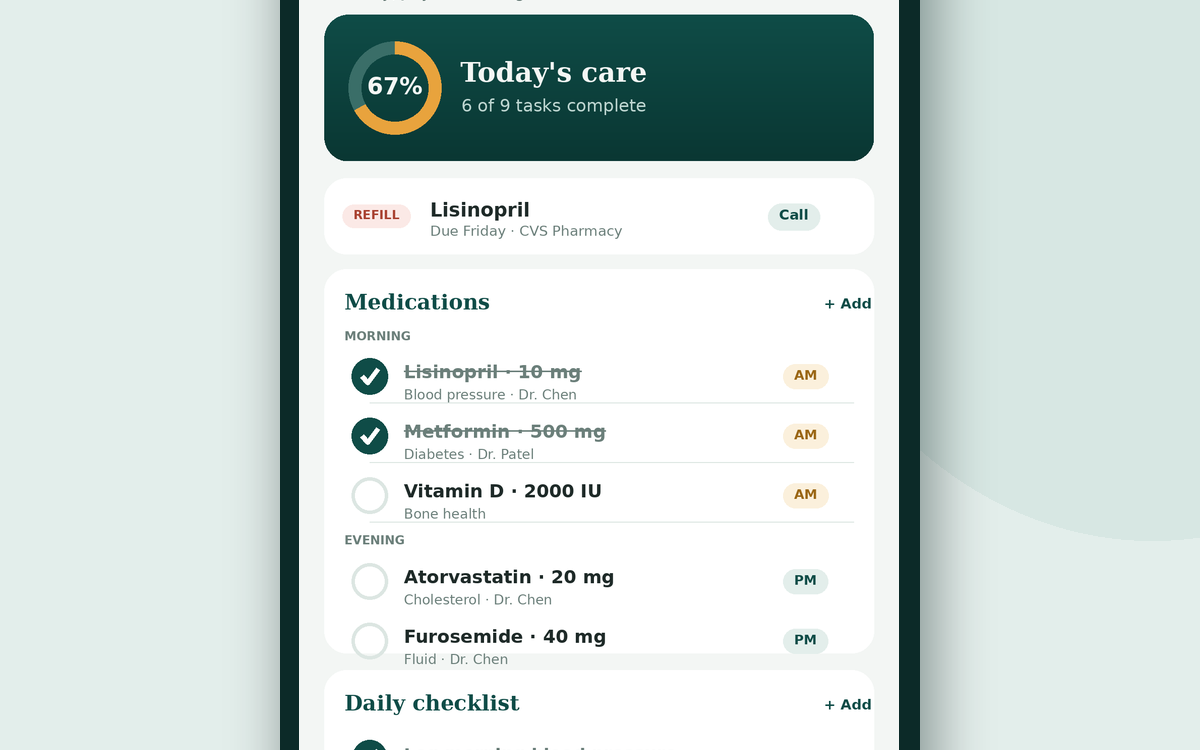
Rewrite your list into groups: morning, midday, evening, bedtime, and as needed. Now the question stops being “what does she take?” and becomes “what is left for tonight?” — a question you can actually answer at a glance.
If a medication is taken twice a day, it appears in two groups. That looks redundant on paper and works perfectly in practice.
Step 3: Set up a refill routine before you run out
Running out of a medication on a Saturday is one of the most common, most avoidable caregiving crises. Two habits prevent nearly all of them.
Ask your pharmacy about synchronizing refills
Most pharmacies can align prescriptions so they come due on the same day each month instead of scattered across four weeks. Call and ask whether they offer medication synchronization. One pickup a month replaces five.
Order at the three-quarter mark, not the last pill
When a bottle is about a quarter full, request the refill. That leaves room for prior authorizations, back-orders, and the doctor being out of the office — the three things that turn a routine refill into an emergency.
Keep all of this in one place
Caregiver Help tracks medications, vitals, appointments, and medical records on your own phone — private, with nothing uploaded to anyone.
See how it works $7.99/month or $19.99 once · works on any phone or computerStep 4: Give yourself one place to check off doses
A list tells you what should happen. You also need a record of what did happen — that's what ends the “did she already take it?”问题. Three approaches work, and the best one is the one you'll actually keep up.
The weekly pill organizer
Cheap, visual, and immediately obvious when a compartment is still full. Fill it the same day every week. The limitation: it doesn't travel well, it doesn't handle liquids or inhalers, and it tells you nothing about when a dose was taken.
The paper log on the refrigerator
A simple grid — days across the top, medications down the side. Anyone who walks in can see the state of the day, which matters enormously when care is shared between siblings or with a home health aide.
A tracker on your phone
The advantage is that it's with you when you're not home, it can remind you, and it keeps a history you can show the doctor. Caregiver Help was built for exactly this: morning and evening checklists that reset each day, refill alerts, and a one-tap call button for your pharmacy.
Step 5: Bring the list to every single appointment
Doctors can only prescribe safely around what they know about. Specialists often can't see each other's prescriptions, and neither can they see what the previous hospital stay changed.
Bring your list — printed, or on your phone — to every visit, and ask directly: “Looking at everything she takes, is anything here doing the same job twice, or working against something else?” This question alone regularly catches duplicates.
Some pharmacists offer a medication review where they go through everything together. If yours does, take them up on it. It's often free and pharmacists catch interactions that get missed elsewhere.
What to watch for between appointments
You don't need clinical training to notice change. You need to know what to write down.
Worth noting and reporting
- New drowsiness, dizziness, or confusion after a medication change
- Falls or near-falls — even without injury
- Nausea, appetite loss, or a new rash
- Swelling in the ankles or sudden weight gain over a few days
- Anything that started around the time a new prescription did
Three mistakes that cause most medication problems
Keeping the list only in your head. It works until the day you're sick, traveling, or in an ER at 2am and someone else needs it.
Leaving supplements off the list. Common over-the-counter products and herbal supplements interact with prescriptions in real ways. If it's swallowed, it goes on the list.
Not updating after a hospital stay. Hospital discharge is when medication lists change most — doses adjusted, drugs stopped, new ones added. Rebuild your list the day you get home, from the discharge paperwork, not from the bottles in the cabinet.
The goal isn't to become a nurse. It's to stop carrying it all in your memory.
Stop keeping it all in your head
Medications, vitals, appointments, records, and reminders — organized on one calm screen, made by a caregiver for caregivers.
Try Caregiver Help $7.99/month or $19.99 once · 14-day money-back guaranteeFrequently asked questions
How do I keep track of medications for a parent who lives alone?
Start with the same master list, then choose a system your parent can use independently — usually a weekly pill organizer filled by you on a set day, plus a phone reminder. Ask them to text you when a dose is taken if they're able. Many families also share a tracker so both people see the same checklist.
What should I do if I think my parent missed a dose?
Don't double up. Call the pharmacy or the prescribing office and ask what to do for that specific medication — the right answer differs by drug. Then write down that it was missed so you can tell the doctor if it happens often.
Is a pill box or an app better for tracking medications?
A pill box is best for the physical act of sorting doses; an app is best for keeping the history, reminders, and refill dates. Many caregivers use both — the box for the week's pills, the app for the record and alerts.
How often should a parent's medication list be reviewed by a doctor?
Ask for a full medication review at least once a year, and always after a hospital stay or when a new specialist is added. If your parent takes several prescriptions, many pharmacists will also do a review on request.